

Understanding
Applied Behaviour Analysis
Applied Behaviour Analysis (ABA) is a scientific discipline that studies behaviour and learning. ABA focuses on understanding how behaviour is influenced by environmental events and how this knowledge can be used to support meaningful skill development and behaviour change.
Behaviour analysts apply principles of behaviour and learning to help individuals develop functional skills, increase independence, and improve quality of life across a variety of settings.
ABA at a Glance
- ABA is a scientific discipline focused on behaviour and learning.
- The field is supported by more than 70 years of research.
- ABA uses data to guide decision-making.
- Interventions are individualised.
- ABA supports individuals across the lifespan.
- ABA is used in disability services, education, healthcare, and community settings.
What is Applied Behaviour Analysis?
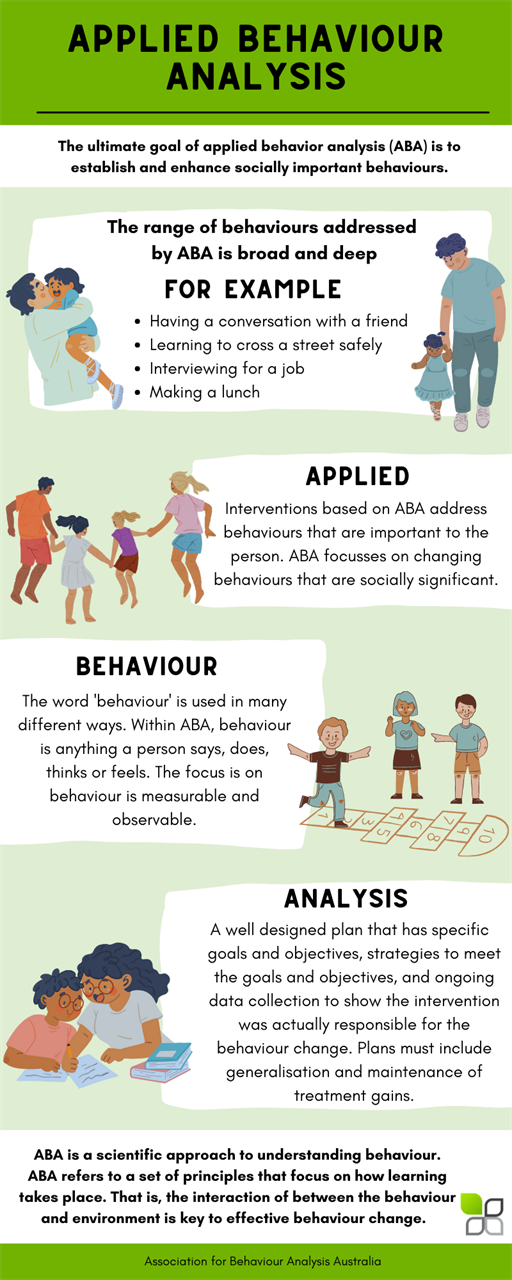
Key Concepts of
Applied Behaviour Analysis
Applied Behaviour Analysis is based on scientific principles that explain how behaviour works and how learning occurs. These concepts guide behaviour analysts when assessing behaviour, designing supports, and evaluating progress.
Behaviour is Influenced by the Environment
Behaviour does not occur in isolation. It is influenced by events that occur before a behaviour and events that occur after it. Understanding these relationships helps behaviour analysts identify why behaviour occurs and how to support positive change.
Behaviour Can Be Measured
ABA emphasises careful observation and measurement. By collecting data over time, behaviour analysts can determine whether an intervention is effective and make adjustments when needed.
Learning Occurs Through Reinforcement
Reinforcement is a key process in learning. When behaviour is followed by meaningful and motivating outcomes, that behaviour is more likely to occur again. Behaviour analysts use reinforcement to help individuals develop new skills and strengthen positive behaviour.
Skills Can Be Taught Systematically
Complex skills can be broken down into smaller steps and taught gradually using structured teaching methods. This helps individuals build skills in areas such as communication, independence, and social interaction.
Interventions Are Individualised
ABA interventions are tailored to the strengths, needs, and goals of each individual. Behaviour analysts design supports based on assessment results and collaborate with the individual, family members, and other professionals.
Why Evidence Matters
ABA is recognised internationally as an evidence-based approach to supporting behaviour change and skill development.
The field is built on more than 70 years of scientific research, with thousands of peer-reviewed studies examining how behaviour works and how effective interventions can be developed.
Evidence-based practice means that behaviour analysts integrate:
The best available research evidence
Professional expertise and judgement
The values, preferences, and goals of the individual and their family
Using evidence-based approaches helps ensure that supports are effective, ethical, responsive to individual needs, and focused on improving quality of life.
Quality of Life and Person-Centred Practice
ABA focuses on supporting meaningful improvements in a person's daily life. Behaviour analysts work collaboratively with individuals, families, and support teams to identify goals that are important to the individual.
Meaningful Outcomes
communicating needs and preferences
participating in school, work, or community activities
developing friendships and social relationships
learning daily living skills and independence
increasing safety and well-being
reducing barriers that limit participation in everyday life
Person-centred practice means that supports are designed around the individual's strengths, goals, and preferences. Behaviour analysts seek to understand what matters most to the individual and to work collaboratively with their support network to achieve those outcomes.
Training and Professional Standards
Behaviour analysis is a specialised field that requires advanced education, supervised practical training, and adherence to professional and ethical standards.
Behaviour assessment methods
Functional behaviour assessment
Skill development and teaching strategies
Data collection and analysis
Ethical and professional practice
Many behaviour analysts complete postgraduate training in behaviour analysis or related disciplines and undertake extensive supervised practical experience before practising independently.
Ongoing professional development is also an important part of behaviour analytic practice, helping practitioners remain up to date with current research and evidence-based approaches.
Professional Standards
Formal education in behaviour analysis
Supervised practical experience
adherence to a Code of Ethical Practice
Ongoing professional development
Accountability to a professional body
Common Questions and Misconceptions
Separating fact from fiction about ABA
Myth
ABA is only for autism.
Fact
While ABA is widely used in autism support, the science of behaviour analysis applies more broadly. ABA principles are used in disability services, education, mental health, healthcare, and other settings.
Myth
ABA only focuses on reducing behaviours of concern.
Fact
A major focus of ABA is teaching new skills. Behaviour analysts support communication, social interaction, emotional regulation, daily living skills, independence, and community participation.
Myth
ABA uses the same program for everyone.
Fact
ABA interventions are highly individualised. Behaviour analysts conduct assessments to understand each person's strengths, preferences, goals, and environment, then tailor supports accordingly.
Myth
ABA relies on punishment.
Fact
Modern ABA practice emphasises positive reinforcement, supportive teaching strategies, and least-restrictive approaches that promote dignity, safety, and well-being.
Myth
ABA tries to change who a person is.
Fact
The goal of ABA is not to change a person's identity. Behaviour analysts support the development of skills that increase independence, communication, safety, and participation in daily life while respecting preferences and values.
Myth
ABA ignores emotions.
Fact
Behaviour analysts recognise that behaviour is influenced by many factors, including life experiences, biology, and environment. ABA often supports emotional regulation, coping strategies, and communication of needs.
Myth
ABA is only for young children.
Fact
Behaviour analysis can support individuals across the lifespan, including children, adolescents, adults, and older adults in a range of settings.
Common Questions About ABA
What does ABA stand for?
ABA stands for Applied Behaviour Analysis, the scientific study of behaviour and learning.
What does a behaviour analyst do?
A behaviour analyst assesses behaviour, develops individualised supports, teaches skills, and monitors progress using data.
Is ABA evidence-based?
Yes. ABA is supported by decades of scientific research and is widely recognised as an evidence-based approach.
Is ABA only used in autism support?
No. ABA is widely used in autism support, but the science of behaviour analysis is also applied in education, disability services, healthcare, mental health, and other areas.